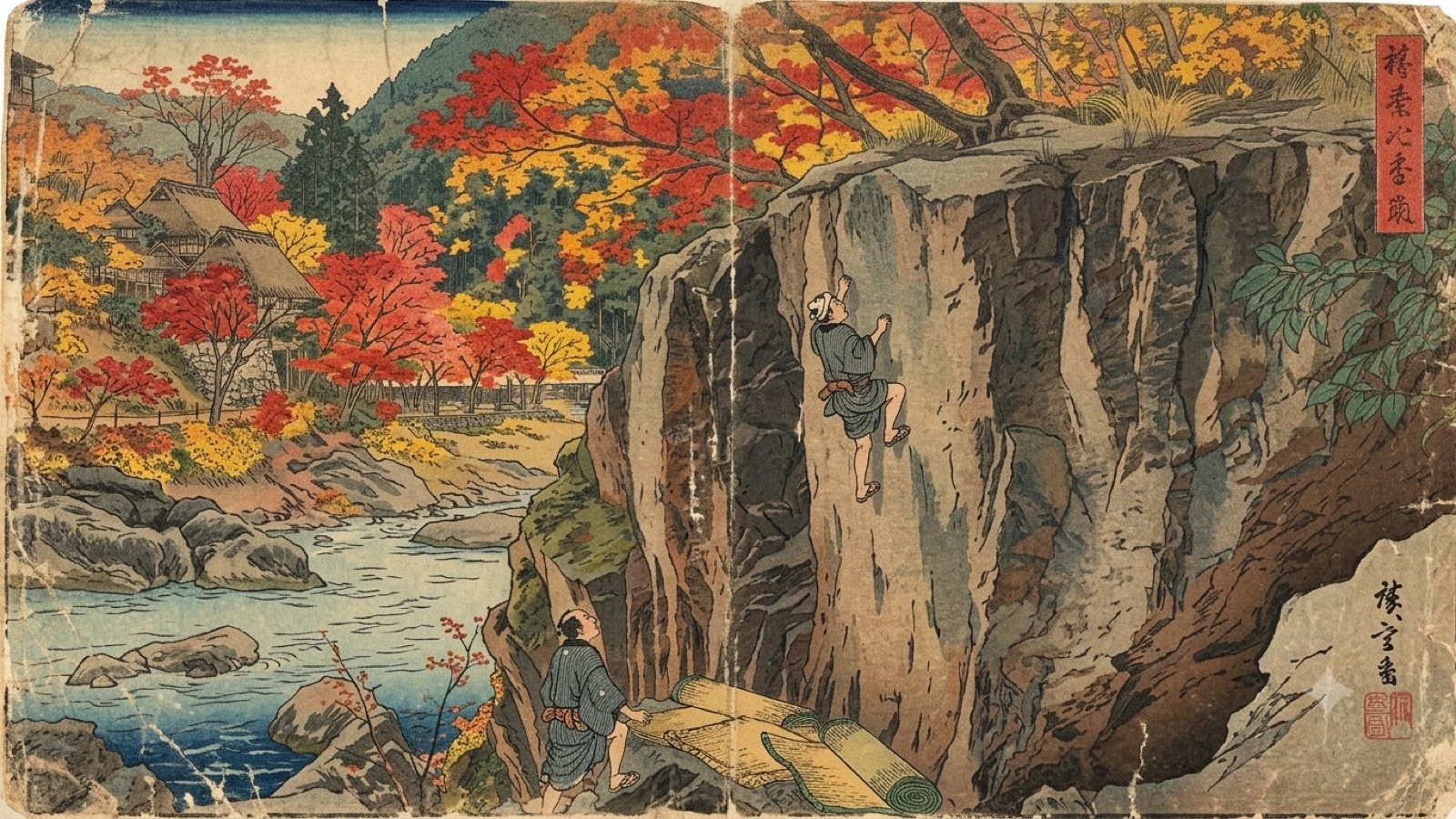
Ukiyo-e style woodblock print of climbers on a river boulder at Mitake in autumn
多摩川の岩
KANTO · CRAG 01 · OKUTAMA, TOKYO

Mitake 御岳

River bouldering inside Tokyo's own prefecture — one train from Shinjuku, no car, no rental van, no excuses.

DISCIPLINEBouldering
ROCKRiver-polished blocks
ACCESSTrain + 10 min walk
TRIP LENGTHDay trip
岩の性格 — THE ROCK

Short, polished, technical

Boulders lie along the riverbed rather than in one sector. Problems are short and slick from decades of traffic, so footwork beats power. Landings are rock and gravel, sometimes sloping into water.

Grades are Japanese kyu and dan. If you only know V-grades, convert before you pick a project.

Grade converter →
STYLESlopers, compression, polished feet
HEIGHTMostly 3–5 m, a few highballs over bad ground
LANDINGSRock, gravel, occasionally the river itself
TOPOJapanese guidebooks, plus an English edition on sale
SIGNALUsable near the station, patchy in the gorge
季節と水位 — SEASON & WATER

Come in spring or autumn

Mitake climbs all year on paper. In practice the river and the humidity decide your day.

JANCold
FEBCold
MARGood
APRPrime
MAYPrime
JUNRainy
JULHumid
AUGHumid
SEPTyph.
OCTPrime
NOVPrime
DECCold

Cool air, low water and dry rock line up twice a year. Spring gives you long light and cherry blossom crowds on the path; autumn gives you the best friction of the year and a river low enough to reach blocks that are underwater in June.

If you only have one weekend in Japan, aim at the first half of November.

Rain upstream in Okutama arrives here hours later. Blocks that sat on dry gravel in the morning can be standing in fast water by afternoon, and the polished starts stay greasy long after the sun is out.

Check the upstream forecast, not just Tokyo's, and have a gym in Ome or Tachikawa as the backup plan.

July and August are hot and sticky, but the gorge is shaded and the water is cold. Locals treat it as a swim day with some climbing attached: start at first light, stop by eleven, get in the river.

Take twice the water you think you need — there is no shop between the station and the blocks.

Friction is excellent and the crag is empty, but the sun leaves the riverbed early and the temperature drops with it. Plan a short, focused session and bring more layers than a Tokyo day suggests.

Ice on the approach path is a real risk after a cold night.

Autumn Saturdays put walkers on the shrine road, rafts on the water and a queue on the popular blocks. Weekdays are a completely different crag — quiet enough that you will hear the river over your own breathing.

If you must come at the weekend, take the first train and be off the classics before ten.

道程と駐車 — ACCESS & PARKING

Shinjuku to the riverbed

Most trains from Shinjuku only run as far as Tachikawa or Ome, so you will change once or twice. Read the destination on the front of the train rather than trusting the platform: the same platform sends trains to three different valleys.

CHANGE ATTachikawa, then Ome. Cross-platform in most cases.
WEEKENDSSeasonal direct rapid services to Okutama run on some weekends — worth checking, they save a change.
PADSAvoid the 07:00–09:00 commuter peak with a pad on your back. Nobody will say anything, and that is exactly the problem.

The Ome Line thins out west of Ome — one or two trains an hour, fewer in the evening. Photograph the departure board when you arrive; there is no service to fall back on and taxis out of the valley are expensive.

AT THE STATIONToilets, vending machines and a small number of coin lockers. No supermarket.
LAST TRAINMid-evening. Leave the boulders with an hour in hand — the walk up is uphill and longer than you remember.
TICKETSSuica or Pasmo works the whole way. Keep some cash for the return if your card runs low; top-up machines are limited.

Leave the station, cross to the river side of the main road and take the road down toward the bridge. From the riverside path the blocks are spread both upstream and downstream — this is a linear crag, not one sector.

{{IMAGE_MITAKE_APPROACH}}
approach map: station to riverbed
SURFACEPaved road, then loose river stone. Wet rounded rock is the most common way to twist an ankle here.
CROSSINGSSome blocks sit on the far bank. Only cross where it is obviously shallow, and never after rain.
駐車場 — PARKING GUIDE

Paid lots only — or take the train

Free beta. Parking is the single fastest way climbers lose an area.

The valley road is narrow, the few paid lots are shared with hikers and rafting customers, and they fill early on any fine weekend. Climbers parking badly here is precisely how riverside access gets restricted — the train exists for a reason.

WHEREMarked paid lots near the station and along the valley road only.
WHENBefore 08:00 at weekends and through autumn. After that, assume full.
PAYMENTCash machines and honesty boxes. Carry coins and small notes.
NEVERConvenience store and restaurant lots, the bus turnaround, the shrine road, private driveways, or the verge "just for an hour".
駐車禁止 — NEVER PARK HERE

Read this before the lot list

To prevent trouble with residents and keep climbing access alive, absolutely avoid parking in these places.

✕Gyokudo Art Museum toilet lotThe lot in front of the toilets just above the museum is for brief toilet stops only. Long climbing-day parking is strictly forbidden. [GPS 35.8001, 139.1841]
✕Mitake 1-chome lot (near Mitake Tunnel)A free lot just past the tunnel coming from the city side — also toilet-stop use only, not for climbers. [GPS 35.8005, 139.1795]
✕Ome-kaido (Route 411) & residential shouldersRoadside parking is banned throughout the area — it blocks emergency vehicles and residents. Walking a little further to an official lot is the strict local rule here.
地図 — PARKING MAP

Red = never park · Blue = official lots

1Official lot — park here✕Never parkDRAG TO PAN · +/− TO ZOOM · TAP A PIN OR A CARD BELOW

Pins match the cards below — tap a card to fly to its pin. Roadsides and vacant lots anywhere around the area are strictly no-parking: illegal parking risks closing the whole area. Switch to Satellite to see the actual lot surface before you drive in.

駐車可能エリア — WHERE YOU CAN PARK

Official lots around Mitake

From free lots to convenient paid ones — these are the officially usable options.

FREE · ~48 CARS1Kanzanji Temple Parking寒山寺駐車場Free. Open 24 hours. About 48 spaces.35.802805, 139.194562 ↗
PAID · ~53 CARS2Mitake Enchi Parking御岳苑地駐車場¥100/hr, max ¥800/day. Free Dec 1 – end of Feb. Height 2.5 m / width 1.9 m limit.35.799088, 139.177396 ↗
PAID · 16 CARS3Ome City Mitake Community Center青梅市御岳交流センター駐車場¥500/visit, charged on designated days only. Free Dec 1 – end of Feb. Open 7:00–19:00.35.800300, 139.182400 ↗
駐車禁止 — NEVER PARK HERE

These spots get areas closed

NO PARKING · MUSEUM LOT✕Times Parking Ome Mitakeタイムズパーキング青梅御岳Tied to the Gyokudo Art Museum (¥300/60 min · 40 spaces). Do not park here to climb.35.80021, 139.18512 ↗
NO PARKING · TOILET STOPS ONLY✕Mitake 1-chome Lot御岳1丁目駐車場About 4 spaces. No all-day or long-stay parking — brief toilet stops only. There has been trouble with neighbours over climber parking here.35.79957, 139.1851 ↗
NO PARKING · EVERYWHERE ELSE✕Roadsides & vacant lots around the areaエリア周辺の道路・空き地Street parking and parking on private land is strictly forbidden — it is the fastest way to get the whole area closed.
A NOTE FROM THE AUTHOR

Every boulder you touch here stayed open because a first generation of local climbers did the hard, patient work — developing problems, and building trust with landowners and local government one conversation at a time. "I didn't know, I'm from abroad" changes nothing for the neighbours: to them, it is simply a climber breaking the rules. Please follow every area rule without exception.

御岳の掟 — LOCAL RULES

Mitake is somebody's neighbourhood

Houses, an inn district and a walking route sit within earshot of the boulders. The five national rules apply here in full — these three decide whether Mitake stays open.

岩は借り物

The gorge walls throw sound straight up into the houses and the inn district above the river. What feels like normal encouragement at a crag arrives in someone's living room as shouting.

Give beta from close by, keep sends quiet, and leave the speaker in your bag. Drone flying over the valley will get the police called.

Fishing seasons, rafting companies and walking groups all have a claim on this riverbank, and several of them pay for it. Keep pads off the footpath, never block the water's edge, and move your kit rather than making someone ask.

A short greeting in Japanese defuses almost every encounter here.

White holds and tick marks on a riverside boulder are visible from the path, and they are what turns a tolerated activity into a complaint. Brush every hold you touch before you leave, and remove tick marks completely.

Carry a brush. Borrowing one from a stranger every session is not a plan.

RULE 一Designated parking onlyNever park on the street or on private land. Parking is the number one source of access trouble in Japan. RULE 二Carry out every scrap, brush off every markTape ends, food wrappers and finger tape look like suspicious debris. Brush your chalk and tick marks off the rock before you leave — Leave No Trace is the fundamental rule. RULE 三Never chip or cutAltering a hold is the most shameful act in climbing. Cutting a tree at a start can also be a criminal offence. RULE 四Keep your voice downWhere houses stand close to the boulders, shouts and cheers are simply noise. Leave the speaker at home as well. RULE 五No fire, no campingCampfires and stoves risk wildfire. Tents, car camping and night bouldering get reported as suspicious activity.
Read the Five Rules in full
PAD RENTALS

No pad? Rent one here

How to rent a pad for Mitake, step by step →

Rent near Mitake Station and head out from Tokyo empty-handed — 1,000–1,500 JPY/day. Pads sell out fast on weekends; book ahead.

maunga (Mitake Main Store)1,500 JPY/day. A used outdoor gear shop — rock brushes lent free, no booking needed. Book on their online form (English labels) by 19:00 the day before.maunga.jp ↗Booking form ↗
Inoue ShotenA former liquor store right in front of Mitake Station — unbeatable access for train-bound climbers. No website; check at the store.
Concept (Tamagawa Rafting Tour)1,000 JPY/day, 8:00–20:00. A rafting facility that also rents crash pads, with long, flexible hours.canoebar.jp ↗
有料資料 — PREMIUM PACKS

Take the whole topo with you

Everything on this page stays free. The packs add the problem data, coordinates and offline maps you cannot carry from a web page.

高難度課題 — LOCAL LEGENDS

For the strong and the curious

Not a sales pitch — just what the locals are trying when conditions come good.

LOCAL LEGEND{{LEGEND_1_GRADE}} {{LEGEND_1_NAME}} {{LEGEND_1_NOTE}}
LOCAL LEGEND{{LEGEND_2_GRADE}} {{LEGEND_2_NAME}} {{LEGEND_2_NOTE}}
雨の日 — RAINY DAY PLAN

When the rock is wet

Free beta. Nearest gym, a bath, and one thing worth seeing on a rest day.

GYMCOMING SOONWe are checking this locally before we publish it.
ONSENCOMING SOONWe are checking this locally before we publish it.
OFF-DAYCOMING SOONWe are checking this locally before we publish it.
混雑予測 — CROWD FORECAST

When Mitake is quiet

A local-feel estimate, not a live feed. Replace each cell with Quiet / Moderate / Busy.

QUIET MODERATE BUSY
SEASON
WEEKDAY
SATURDAY
SUN & HOLIDAY
SPRING
Quiet
Busy
Busy
SUMMER
Quiet
Busy
Busy
AUTUMN
Moderate
Busy
Busy
WINTER
Quiet
Moderate
Moderate
旅の支度 — BEFORE YOU FLY

Three things you cannot fix on arrival

Japanese transfer apps are the difference between catching the connection at Tachikawa and waiting forty minutes for the next one. Install and activate before you land — airport queues eat the first morning of a short trip.

Which eSIM works for climbers →

A handful of Tokyo gyms and shops rent pads, usually by the day and usually requiring a reservation. Pick them up the evening before, not on the morning of the trip, and check the return time — most want them back before closing.

Where to rent pads →

Bouldering is treated as a hazardous activity by many insurers, and Japanese medical care is not cheap. Check that the policy names climbing, and that it covers transport home if you break something.

Compare policies →
装備と補給 — GEAR & SUPPLIES

Pack for a day with no shops

備えあれば
ESSENTIALTwo pads minimum between two climbers, plus a brush.
ESSENTIALAll your water and food. Shops sit by the station, nothing at the boulders.
ESSENTIALCash. Small shops, lockers and the bus do not all take cards.
ADVISEDApproach shoes with grip — the riverbed is wet, round and unforgiving.
ADVISEDA rubbish bag. There are no bins anywhere in the valley.
ADVISEDOffline map downloaded before you leave the station.
下山のあと — AFTER CLIMBING

Onsen, soba, last train

BATHDay onsen near the stationCheck the tattoo policy before you undress — some baths still refuse entry.Tattoo policy →
FOODSoba on the main roadSmall places, early closing, mostly cash. Eat before the evening wave of hikers, or plan on a station bento.
STAYOr go home the same dayMitake is a day trip. For two days, sleep in Ome or in the inn district up the hill — not in your car.
万一のとき — IF IT GOES WRONG

Know this before you pull on

119Ambulance and rescue. Say your location in simple English and stay on the line.
GETTING OUTThe riverbed is close to the road — an injured climber can be walked out in minutes. Know which bank you are on.
WATERLevels rise without warning after upstream rain. Do not cross to blocks you cannot get back from.
COVERTravel insurance often excludes climbing. Check the wording before you need it.
道中案内 — PREMIUM PACK

Want the full logistics for Mitake?

Two packs, one area at a time. Take the whole area, or buy all three Kanto areas together at a discount.

Mitake Bouldering TopoEvery documented problem with YouTube video links, an overview map and GPX tracks.$24
Kanto Master Bundle — three areasArea Pack for Mitake, Ogawayama and Mizugaki — around 30% off buying them separately.$59was $84
Get the Mitake Bouldering Topo — $24 ↗ Or take all three areas: Kanto Master Bundle $59 →
{{IMAGE_ITEM_MITAKE}}
pack thumbnail