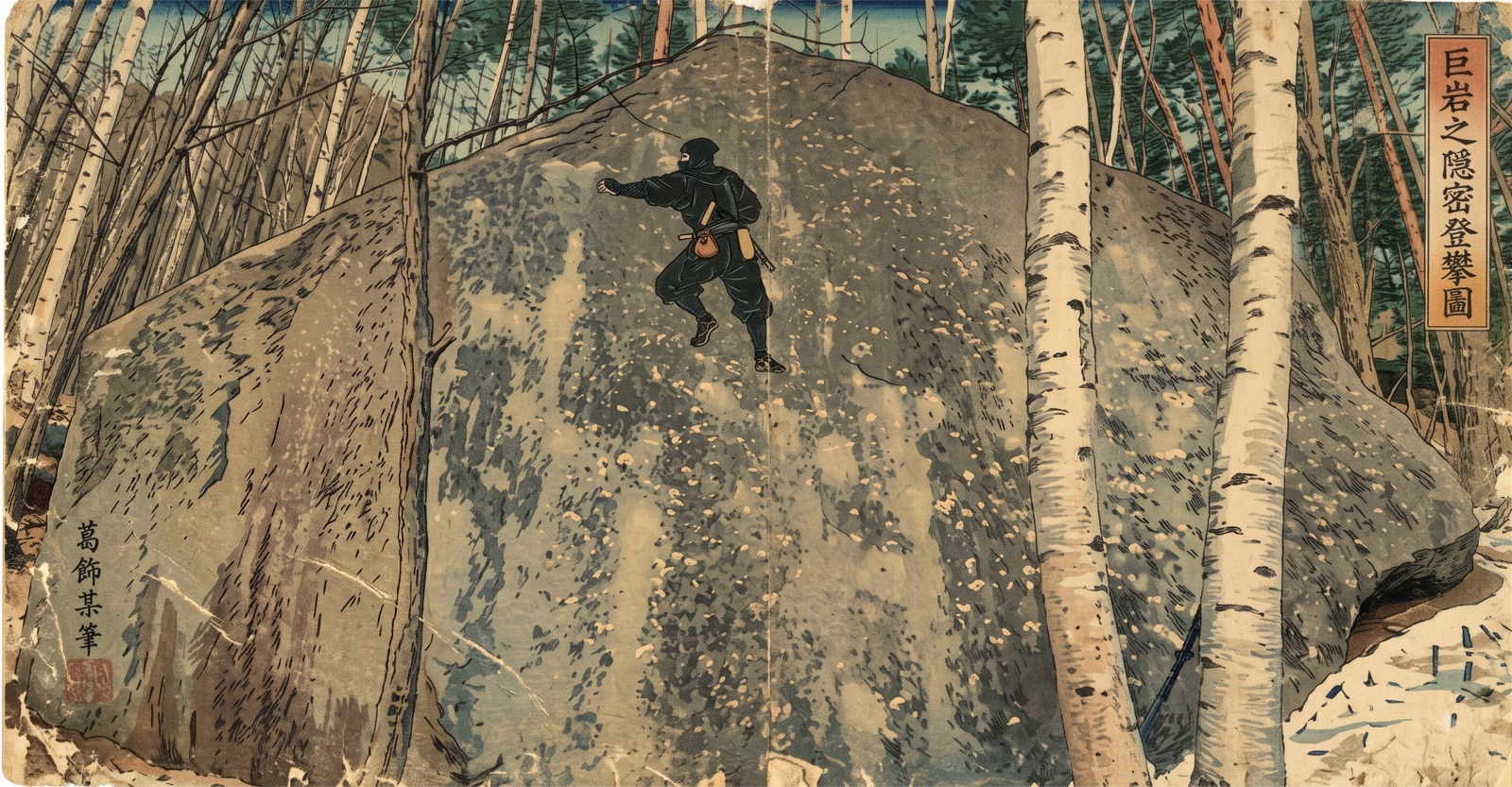
A whole valley of granite
Hundreds of boulders sit alongside slabs, crack lines and multi-pitch walls on both sides of the valley. Approaches run from five minutes to over an hour, so choose a sector for the day rather than wandering.
Friction is superb and the rock rewards precise feet. Trad lines are often run out by modern standards — bring a rack and judgement, not just quickdraws.
Grade converter →The one Japanese crag that works in summer
High enough to stay cool in August, high enough to shut for winter. The campground calendar defines the season.
Autumn brings cold granite, stable weather and the valley at its best — and everyone else at the same time. Early summer is quieter, greener and only slightly less good for friction.
For a first visit, mid-September to mid-October is the safest bet.
This is where Japanese climbers escape the lowland humidity. Sectors in shade climb well through the hottest weeks; sunny slabs do not. Plan the day around aspect rather than around the clock.
Afternoon thunderstorms are common — have a descent plan before you start a long route.
The campground sits high in the mountains and loses heat the moment the sun drops behind the ridge. Bring an insulated mat as well as a warm bag — the ground takes more warmth than the air does.
A hot meal and a flask beat any amount of extra clothing.
Dates move each year with the first snow. Once the campground shuts there is no base, no water and no reason to drive up — confirm this season's opening and closing before you book flights around a late-autumn trip.
On a peak weekend the clearing fills with tents and the popular sectors queue. Arriving Thursday changes the whole trip: a decent pitch, an empty crag on Friday, and company when you want it.
It is also the best place in Japan to meet local climbers. Say hello — beta and lifts follow.
Tokyo to Kawakami valley
Expressway toward Nagano, then valley roads up into Kawakami. The last section climbs steadily and is single-track in places; in the dark, with tired eyes, it is the hardest part of the trip.
The Koumi Line runs a handful of services a day and they do not wait for your connection. Build the whole journey around one specific train, and have the next one written down in case you miss it.
There is no rank at the station and no app coverage you can rely on. Reserve the taxi before you travel, confirm the pickup point, and book the return leg at the same time if you are not driving out with someone.
access map: station to Mawarimedaira
Where to leave the car
Free beta. Parking is the single fastest way climbers lose an area.
Every sector walks from the same clearing, so there is no reason to move the car during your stay. Roadside parking on the approach — even briefly, even to unload — is the behaviour the village complains about.
Read this before the lot list
Every sector walks from the same clearing, so there is no reason to move the car during your stay. Roadside parking on the approach — even briefly, even to unload — is the behaviour the village complains about.
Blue = official lots · verges are never OK
Cards 1 and 2 are the same site, so they share one pin — tap a card to fly to it. The never-park zones are the approach-road verges and passing places along the whole valley road, so there is no single pin for them. Switch to Satellite to see the lot surface.
Official lots around Ogawayama
Every boulder you touch here stayed open because a first generation of local climbers did the hard, patient work — developing problems, and building trust with landowners and local government one conversation at a time. "I didn't know, I'm from abroad" changes nothing for the neighbours: to them, it is simply a climber breaking the rules. Please follow every area rule without exception.
A working village, not a resort
Kawakami farms this valley and climbers are guests on its roads. The five national rules apply in full — these three are what locals notice immediately.
Lettuce farming runs to a tight schedule and the access tracks are working infrastructure, not lay-bys. A car left in the wrong place at harvest time costs someone money, and the whole climbing community gets the blame.
Park at the campground, pay the fee, walk. That is the entire rule.
Most people around you are getting up at five. Keep evening conversation low, use the fire areas provided, wash up only at the sinks, and sort rubbish exactly as the signs instruct — or take it home with you.
Bring your own tableware. Nothing gets washed in the stream.
Ogawayama's ethics were set over decades by the people who developed it. Adding, replacing or removing hardware — however well intentioned — is not a visitor's decision, and neither is scrubbing a new line.
If something looks unsafe, report it at the campground rather than fixing it yourself.
Take the whole topo with you
Everything on this page stays free. The packs add the problem data, coordinates and offline maps you cannot carry from a web page.
For the strong and the curious
Not a sales pitch — just what the locals are trying when conditions come good.
When the rock is wet
Free beta. Nearest gym, a bath, and one thing worth seeing on a rest day.
When Ogawayama is quiet
A local-feel estimate, not a live feed. Replace each cell with Quiet / Moderate / Busy.
Three things you cannot fix on arrival
A car turns Ogawayama from a logistics exercise into a simple drive, and it carries the pads, the rack and a week of food. Reserve early for autumn, and confirm snow tyres for late-season trips.
Renting a car in Japan →Helicopter evacuation from a Japanese mountain is billed to the casualty. Make sure the policy names climbing and mountain rescue, and keep the policy number written down somewhere offline.
Compare policies →Outdoor shops in Tokyo, Kofu and the larger valley towns stock the standard screw-thread canisters. Buy on the way, not at the last village, and check your stove takes the local thread.
Gear and pad rental →Bring the whole trip with you
No pad? Rent one here
Rent at the campground when you register, or at a climber-run shop on the drive in.
Living at Mawarimedaira
Mountain rules apply here
Want the full logistics for Ogawayama?
Two packs, one area at a time. Take the whole area, or buy all three Kanto areas together at a discount.
pack thumbnail